
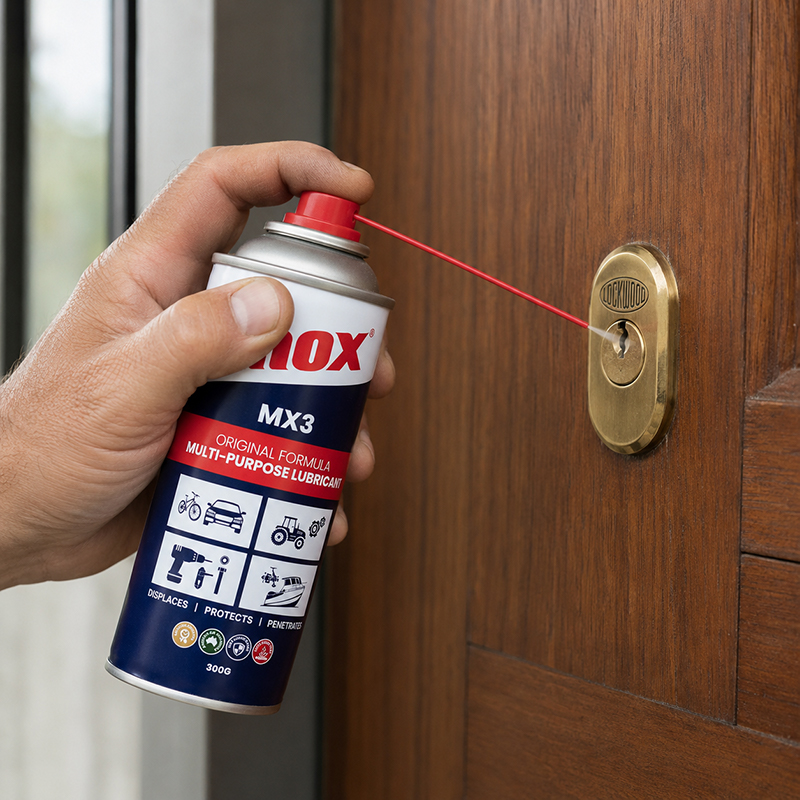
Locks are used every day but are often only noticed when a key becomes difficult to insert, the cylinder feels stiff or the mechanism starts sticking. Regular lubrication with INOX MX3 is a simple maintenance step that can help keep locks operating smoothly and extend their working life.
Why locks need lubrication
Lock cylinders and mechanisms contain small moving components that must move freely and precisely. Over time, dust, moisture, salt, grime and normal wear can increase friction inside the lock. This can make a key harder to insert or turn and place unnecessary strain on the key and internal components.
Applying a suitable lubricant can:
- help keys slide in and out more smoothly;
- reduce stiffness when turning the key;
- reduce friction and wear inside the mechanism;
- help displace moisture and protect against corrosion; and
- reduce the risk of a key bending or breaking because excessive force is being used.
Why we recommend INOX MX3
INOX MX3 is a penetrating lubricant and corrosion inhibitor suitable for maintaining many lock cylinders, padlocks, hinges, latches and other moving hardware. It leaves a protective lubricating film and does not contain silicon, acid, kerosene or dieselene.
Unlike heavy grease or unsuitable general-purpose products, a light application of INOX MX3 lubricates the moving parts without filling the lock with a thick, sticky residue. Only a small amount is required.
How to lubricate a lock
- Insert the applicator nozzle at the entrance to the keyway.
- Apply one short, light spray. Do not flood the lock.
- Insert and remove the key several times.
- Turn the key in both directions to distribute the lubricant through the cylinder.
- Wipe excess lubricant from the key and the face of the lock.
For a padlock, also apply a small amount around the shackle openings and work the shackle several times.
Do not force a stiff lock
Lubrication can help a dry or lightly contaminated lock, but it cannot repair worn keys, damaged pins, a failing cylinder, a misaligned door or a faulty latch. If the lock remains difficult to operate after a light application, stop forcing it. Continuing to use excessive pressure can bend or snap the key and may make the problem more expensive to repair.
Need help with a difficult lock?
If your key is sticking, the lock is becoming unreliable or you are unsure whether it needs maintenance or replacement, contact Abetta Mobile Locksmith. We can inspect the lock, identify the cause and recommend the appropriate repair or replacement.