
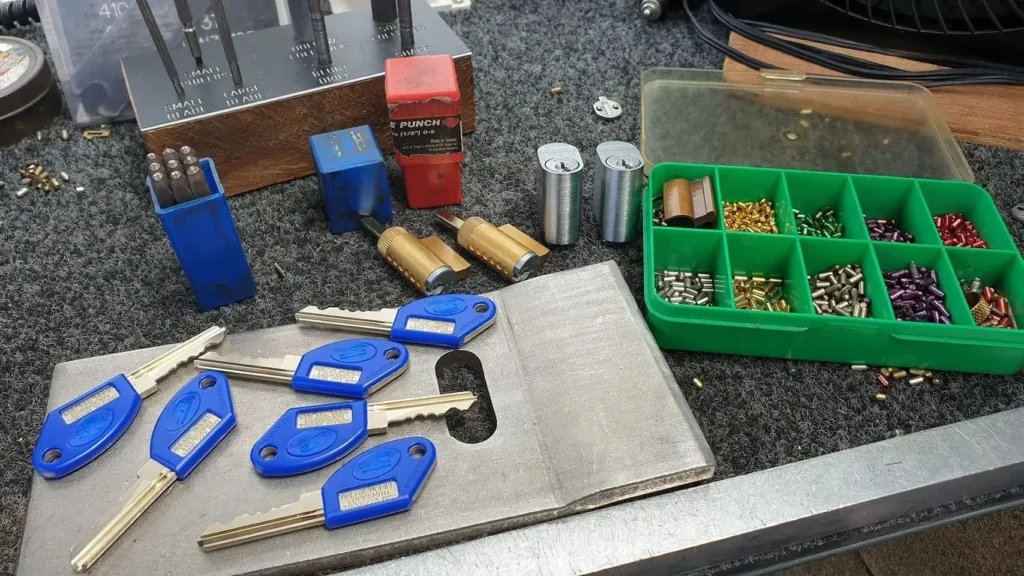
A master key system allows different keys to open different groups of locks. One person may have a key that opens only a single office, while a manager holds a master key that opens several nominated doors.
The purpose is not simply to make one key open everything. A well-designed system creates a controlled access structure that matches how the property is used, who needs access and how that access may change over time.
What is a master key system?
A master key system is a planned arrangement of locks and keys in which each key is assigned a defined level of access. Some keys open only one lock or a small group of locks. Higher-level keys open several groups.
These systems are commonly used in offices, workshops, schools, body corporate properties, warehouses, medical centres, retail premises and managed facilities.
How does a master key system work?
Inside each compatible lock cylinder, the pinning is arranged so more than one authorised key can create the correct operating position. A change key may operate one cylinder, while a master key can operate that cylinder and others within its assigned group.
The technical design must be carefully controlled. Poor planning can create unintended access, make future expansion difficult or result in more people holding broad-access keys than necessary.
Common key levels
- Change key: opens one lock or a defined small group.
- Master key: opens all nominated locks within one section or department.
- Grand master key: may open several master-key groups where the site genuinely requires it.
- Common-area key: allows selected users to open shared entries, gates, amenities or service areas.
Not every site needs every level. The simplest system that properly controls access is usually the best system.
What is the difference between keyed alike and master keyed?
Keyed alike means several locks use the same key. Every holder of that key has the same access.
Master keyed means different users can have different access levels. A staff key may open one office, while a manager key opens multiple offices.
For a small home or simple site, keyed alike may be enough. For a business, school or strata property, a master key hierarchy may provide better control.
Where master key systems are useful
Commercial offices
Staff can be limited to their own work areas, while managers retain broader access to offices, storerooms and meeting rooms.
Warehouses and workshops
Different keys can separate administration, stock, plant, external gates and restricted work areas.
Body corporate and strata properties
Residents may use individual keys for their own units while still opening selected common doors. Building managers and authorised contractors can hold higher-level keys for service areas.
Schools and community facilities
Classrooms, offices, amenities, storerooms and maintenance areas can be grouped according to staff roles.
Medical and professional premises
Consulting rooms, records areas, staff-only spaces and shared entrances may require different access levels.
What are the main benefits?
- Fewer keys for managers and authorised staff
- Clearer access levels
- Reduced need to issue broad access to everyone
- Easier planning for departments, tenancies and service areas
- Potential to combine individual access with shared common doors
- Better long-term key administration when supported by proper records
What are the risks?
A master key can open many doors, so losing one may create a significant security problem. The broader the key’s access, the greater the impact.
Common risks include:
- Too many people holding master keys
- Keys not being returned when staff or contractors leave
- Poorly maintained key registers
- Adding locks without updating the system plan
- Over-complicated hierarchies
- Uncontrolled duplication of ordinary keys
For stronger duplication control, a master key arrangement can be built on a restricted key system.
How is a master key system planned?
The starting point is an access matrix showing which people or roles need access to each door. The planning process should include:
- List every relevant door and lock.
- Identify each user group or role.
- Record which groups require access to which doors.
- Separate common access from restricted access.
- Decide who may hold master-level keys.
- Allow for future doors, staff or tenancy changes.
- Confirm which existing cylinders can be retained.
Can existing locks be used?
Sometimes. Existing cylinders may be rekeyed or incorporated where they are compatible, serviceable and suitable for the proposed hierarchy. Other locks may need replacement.
The answer depends on the keyway, cylinder format, condition of the hardware and the level of access required.
Can a master key system be restricted?
Yes. A restricted master key system combines access hierarchy with controlled key duplication. Additional keys are supplied through an agreed authority process rather than being copied casually.
This can be useful for commercial sites, body corporates, schools and managed properties where both access levels and duplication control matter.
What happens if a master key is lost?
A lost master key should be assessed promptly. The response depends on which doors it opens, whether the key can be identified, whether the system is restricted and how likely it is that the key could be linked to the property.
Some or all affected cylinders may need to be rekeyed. A documented system makes this assessment faster and more accurate.
How large can a master key system be?
Systems can range from a handful of doors to much larger commercial hierarchies. The practical limit depends on the selected system, the number of access levels, future expansion and technical design constraints.
Larger does not automatically mean better. A compact, understandable hierarchy is usually easier to administer.
Common planning mistakes
- Giving every supervisor a master key
- Designing around people instead of roles
- Failing to plan for future growth
- Mixing uncontrolled copied keys with formal access levels
- Ignoring common-area access
- Keeping no record of issued keys
- Assuming every cylinder is compatible
Frequently asked questions
Can one key open every door?
Yes, if the system is designed that way, but broad access should be limited to people who genuinely need it.
Can staff keys open common doors as well?
Yes. Individual keys can often be arranged to open selected common doors while remaining limited elsewhere.
Can a master key system be expanded later?
Usually, if expansion is considered during the original design.
Is a master key system suitable for a small business?
Yes. Even a small office, workshop or clinic may benefit from separating staff, management and storeroom access.
Does a master key system stop keys being copied?
Not by itself. Duplication control requires a suitable restricted key platform and authorisation process.
Need help planning a system?
Abetta Mobile Locksmith designs and maintains master key systems for Sunshine Coast businesses, body corporates and managed properties.
View our master key system service, commercial locksmith services, or request a site assessment.