
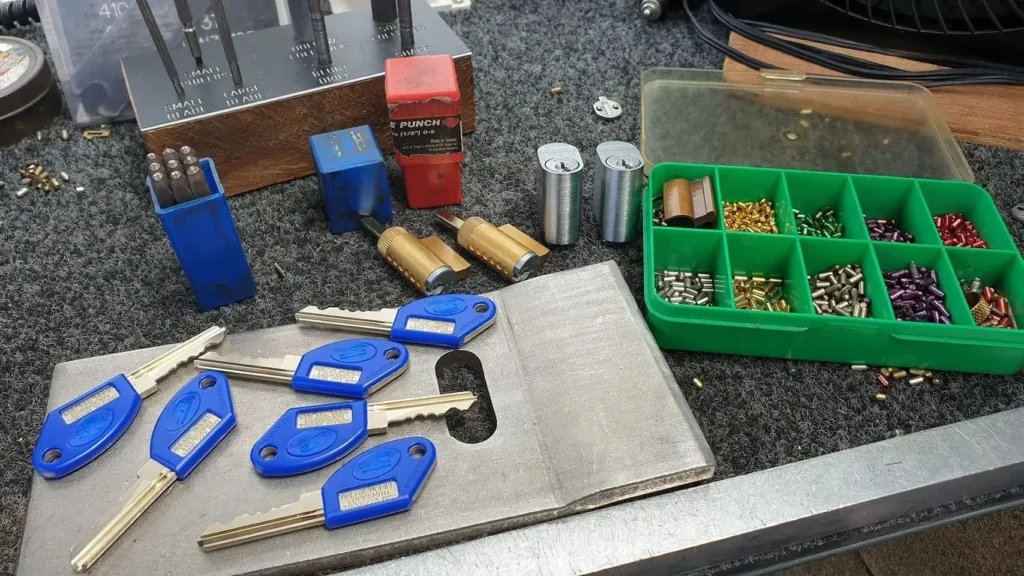
Business locks should be rekeyed when the organisation can no longer confidently account for who has access. That may happen after staff departures, lost or unreturned keys, contractor changes, tenancy changes, a break-in or a breakdown in key records.
Rekeying changes the internal combination of compatible locks so old keys stop working. It can restore control without replacing otherwise serviceable hardware.
What does rekeying a business lock mean?
Rekeying changes the lock cylinder so a new key operates it and the previous key no longer does. The existing lock body may remain in place if it is suitable and in good condition.
For businesses, rekeying can be applied to one door, a group of doors or an entire keyed-alike or master-keyed system.
When should a business consider rekeying?
After an employee leaves
A returned key does not prove that no duplicate exists. Rekeying should be considered when the employee held broad access, worked in a sensitive area, left unexpectedly or did not return all issued keys.
When a key is lost or stolen
The risk depends on which doors the key opens, whether it can be linked to the premises and whether it is a change key, master key or grand master key. A lost high-level key usually requires a more urgent review.
When a contractor or cleaner finishes
Temporary access should not drift into permanent access. If a contractor’s key is not returned or the business cannot verify how it was controlled, rekeying may be appropriate.
After moving into new premises
Previous tenants, owners, agents and tradespeople may still hold keys. Rekeying after handover can restore key control without replacing every lock.
After a tenancy or occupancy change
Commercial landlords, property managers and body corporates should review access whenever a tenancy changes, especially where common-area or service keys are involved.
After a break-in or attempted break-in
Damaged hardware may need repair or replacement, but rekeying may also be required if keys were stolen or security credentials were exposed.
When key records are unreliable
If the business cannot say how many keys exist, who holds them or which doors they open, the access system has become difficult to trust. Rekeying can provide a clean reset.
Should a business rekey every time an employee leaves?
Not always. The right response depends on the key’s access, whether it was returned, whether duplication was controlled and the sensitivity of the areas involved.
A low-level office key that was returned may present less risk than a missing master key. Good records help the business make a proportionate decision.
Rekeying versus replacing locks
| Situation | Likely starting point |
|---|---|
| Locks are serviceable but old keys are unaccounted for | Rekey |
| Hardware is worn, damaged or unreliable | Repair or replace |
| Current lock function is unsuitable | Replace or redesign |
| Business needs controlled duplication | Restricted key system |
| Different staff need different access levels | Master key system |
| Access changes frequently | Consider digital or electronic access |
For a broader comparison, read Should You Rekey or Replace Your Locks?.
How master key systems affect rekeying
In a master key system, one key may open many doors while lower-level keys open only selected locks. Losing a master key can affect a large part of the site.
A documented system allows the locksmith to identify which cylinders are affected and whether the response can be limited or must be broader. Read What Is a Master Key System?.
How restricted keys reduce future risk
A restricted key system controls legitimate duplication through an authorised process. It does not make lost keys harmless, but it reduces casual copying and improves accountability.
Businesses with repeated staff or contractor changes often benefit from combining restricted duplication with a key register and structured access levels. See Restricted Keys Explained.
What should happen before rekeying?
- Identify which key or access level is affected.
- List the doors that key opens.
- Confirm whether the hardware is serviceable.
- Review who still needs access.
- Decide whether keyed alike, master keyed or restricted access is more suitable.
- Update the key register when new keys are issued.
What information should the business provide?
- Number of doors and locations
- Existing key system or key codes
- Which keys are lost, unreturned or compromised
- Who needs access after the change
- Whether the work is urgent
- Photos of the locks, doors and frames
- Any existing key schedule or register
How much does business rekeying cost?
Cost depends on the number and type of cylinders, the complexity of the key system, the number of new keys required, compatibility of existing hardware and whether urgent attendance is needed.
Rekeying is often more economical than replacing good-quality hardware, but replacement may be better value when the locks are already worn or unsuitable.
How often should a business review its locks?
Review access whenever staff, contractors, tenants or premises change. A scheduled review every six or twelve months can also reveal missing keys, outdated access and unnecessary master-level permissions.
The Business Key Control Guide explains how to maintain a practical key register.
When digital access may be better
Where access changes frequently, a suitable digital lock or access-control system may make it easier to add or remove credentials. Digital access still requires administration, maintenance and proper door hardware.
See our digital and smart lock guidance.
Common mistakes
- Assuming a returned key was never copied
- Rekeying one door while ignoring others opened by the same key
- Failing to update the key register
- Keeping too many master keys in circulation
- Replacing good hardware without considering rekeying
- Rekeying worn hardware that should be replaced
- Ignoring access held by cleaners and contractors
Frequently asked questions
Should locks be rekeyed when an employee is dismissed?
It should be considered, particularly where keys are missing, duplication was uncontrolled or the employee had broad access.
Can a business rekey only selected doors?
Yes, depending on the key system and which access level has been compromised.
Will old keys work after rekeying?
No. A properly rekeyed lock is changed so the previous key no longer operates it.
Can a master key system be rekeyed?
Yes, but the affected hierarchy should be assessed carefully to avoid unintended access.
Does a restricted key system eliminate the need to rekey?
No. A lost restricted key can still open the locks it was issued for.
Need a business lock review?
Abetta Mobile Locksmith can assess the affected keys, locks and access levels and recommend whether rekeying, replacement or a better key-control system is appropriate for your Sunshine Coast business.
View our commercial locksmith services, master key systems, restricted key systems, or request a site assessment.