
Worked example • Around $50,000 of contents
For a $50,000 holding, start with an insurer-accepted security specification and separate fire requirements. Avoid selecting a safe simply because its brochure displays the same dollar figure.
ABETTA’s purchasing brief
Seek documented burglary protection accepted for your contents, suitable tested fire protection with a 60-minute starting target for cash and papers, a quality serviceable lock, and professional placement and anchoring to an approved substrate. Consider headroom for growing holdings. Obtain the insurer’s written acceptance before committing.
These are our purchasing recommendations. There is no universal rule that every $50,000 holding must use one particular burglary grade or cost a fixed amount.
First clarify what “$50,000” means
$50,000 entirely in cash
Tell the insurer explicitly that this is money, not general contents. Ask about maximum cash cover and conditions. For a business, use the highest likely overnight holding rather than average daily takings.
$50,000 in jewellery or bullion
Provide valuations and contents categories. Ask about listed valuables, storage conditions and cover away from home. Discuss whether the chosen fire class is relevant to the particular materials.
A mixture of cash and valuables
Break down the categories and their totals. A combined $50,000 holding can encounter different policy limits within the same safe.
How to set sensible headroom
As a planning example, $50,000 plus a $10,000 allowance for future additions gives a $60,000 target holding. That arithmetic is not an industry rating rule. Ask the insurer what specification it wants for that amount; do not assume a supplier’s next advertised cash band automatically satisfies it.
A certified burglary grade gives a more defined comparison than an unsupported marketing claim. Ask suppliers to quote independently graded alternatives alongside any model supported primarily by a manufacturer’s cash recommendation. A grade alone still does not establish your insurance cover.
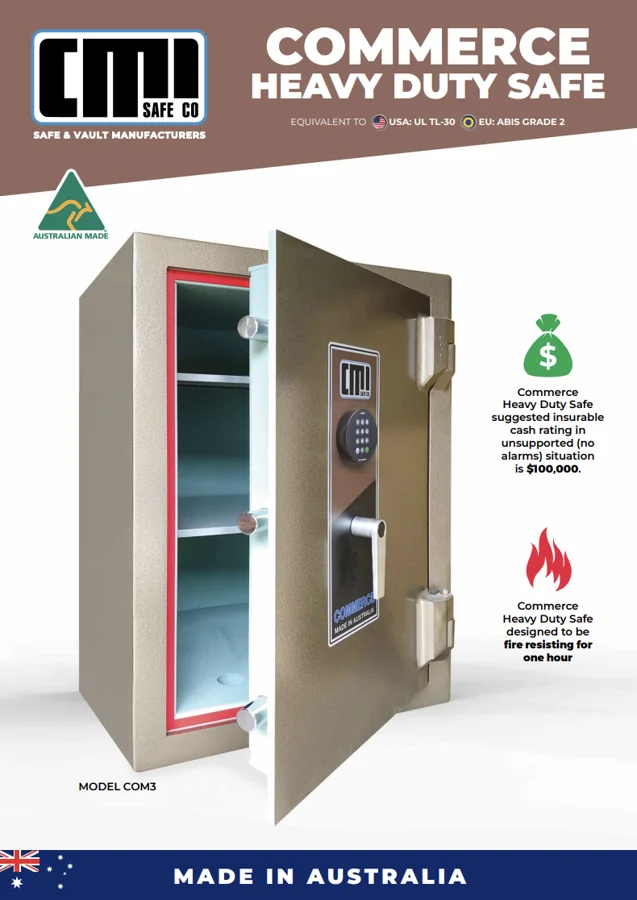
A CMI example showing why the details matter
CMI’s current official information gives Homeguard Plus a suggested unsupported cash figure of $50,000 and 30-minute fire resistance. Commerce is listed at $100,000 and one hour respectively. These are manufacturer statements, subject to exact-model verification and insurer acceptance. Homeguard source · Commerce source.
For someone who wants a 60-minute fire target as well as protection for $50,000, the Homeguard fire specification does not meet that target. Commerce provides a useful comparison enquiry, but its brochure’s “equivalent to” wording must not be presented as proof of independent UL or European certification. See the CMI guide for the evidence checks.
Jorgensen Active Safes is another manufacturer to reference for a model-specific or custom enquiry. We have not established a public cash/fire rating for a particular Jorgensen model suitable for this example, so we do not assign one.
Spend on the specification, then the space
Obtain quotes for the smallest practical capacity that meets your protection, insurance and future-storage requirements. Compare like for like: GST, lock option, delivery, placement, fixing and access costs. A less expensive cabinet plus poor installation can be false economy; extra litres do not compensate for inadequate protection.
No single purchase-price percentage proves suitability. If two installed quotes both meet the agreed specification, compare certificate evidence, usable capacity, warranty, service support and access arrangements. If one quote cannot substantiate its claims, the lower price is not a like-for-like saving.
Insurance companies explain why cover needs checking
Read our direct insurer sources from RACV, AAMI, Suncorp, Allianz and RACQ. They explain cash or valuables limits, specified items and differences between cover at home and away. These support checking your own policy with your insurer; a safe’s advertised rating does not create insurance cover.
Questions to send to the insurer
- Can you cover these contents categories and values against theft and fire?
- What are the money, jewellery and bullion limits and any valuation requirements?
- Do you accept this exact safe and lock configuration for the maximum holding?
- Is an independent burglary grade required? Which certificate will you accept?
- What anchoring, alarm, occupancy or other security conditions apply?
- What records must I retain after installation?
A practical supplier enquiry
“I need to protect approximately $50,000, made up of [contents categories], with a possible maximum of [amount]. Please quote suitable safes with documented burglary resistance and at least 60-minute tested protection appropriate for [paper / media / other contents]. Provide certificates or the basis for each rating, internal dimensions, weight, lock options, anchoring instructions and a complete installed price. The purchase is subject to my insurer accepting the exact specification.”
Review the holding after purchase
Reassess when contents values grow, cash peaks change, the business moves or the safe is relocated. Keep valuations and an inventory separately from the safe, and review installation and access control. Return to Which safe is best for me? Research reviewed 10 October 2026.